Thursday

Autant, M - portrait of Art Nouveau lady

Miniature portraits from the late 19C and early 20C sometimes had an Art Nouveau theme, as with this exceptionally large miniature which has a sight size of 200mm x 130mm. The frame is carved and gilded. Being so large, it has suffered a vertical stress fracture but that does not detract from the unusual subject and the skill of the artist, particularly in depicting the drapery of her dress.

It is signed at the lower left "M Autant". Blattel says little about Autant, other than that he was a Belgian artist active in the 19C. To the left is a stylized forest and on the right a statue of a winged figure on a plinth, looking downwards at a group of romantic or Italianate buildings. It is quite unusual to find a Romanic or Art Nouveau type miniature of a generic nature, depicting a subject matter more often associated with larger paintings of the period.  

There was a M Autant, an architect, who was involved as a witness in the Emile Zola trial, itself connected to the famous Dreyfus trial, but it has not been confirmed that he is same person, although it is possible.

There is also a reference to M Autant in connection with;
SANOUILLET. Lyre & Pallette or Art & Life, which later became Art & Action. A dramatic company formed by Louise Lara, ex-secretary of the French Comedy & her husband Mr. Autant. Courses of dramatic art at the theatres of Paris were offered by the war office, as rallying points for artists dispersed by the hazards of war. These included presentations of the Mamelles de Tirésias (June 1917), Colors of time (Nov. 1918), The Cuirs de Boeuf (Dec. 1918), of Georges Polti to the Academy Rene Maubel, known as of the plays of the world (déc.1918), P. Méral To the Old Dovecote; and The Parade (May 1917), etc See Cat. Collection Art & Action. BLJD, 50.282.


But so far there is no certainty over the identity of this artist. Thus any assistance in identifying him further would be welcomed. 1348

Monday

Helzel, Adolf - Grand Duchesses Olga and Tatiana

A rare and desirable miniature portrait on ivory is this one of the two eldest daughters of Tsar Nicholas II which is signed A Helzel Berlin. It is 70mm in diameter. Depicted in the miniature are Olga (1895-1918) and Tatiana (1897-1918). It was copied from a newspaper photograph of 1913 as shown below.

But when one thinks of the circumstances, it is a rare survivor. A year, later in 1914, Germany was at war with Russia, so a German artist living in Berlin could not risk painting a portrait of the Russian royal family. Four years later the Tsar had been deposed and in 1918 the whole Romanov family was murdered, so it also became dangerous for Russians to own a portrait of their royal family. Thus there can be very few contemporary miniature portraits of the family still in existence.

Blattel records very little about Adolf Helzel, only that he he lived in Bodenbach and Bohemia, was active in 1894, and was an owner of a porcelain painting company with his brothers, Emanuel and Heinrich. Other family members may have included August Helzel, and an earlier glass blower, Wilhelm Helzel. Adolph Helzel exported champagne and other wines glasses to the United States, but the New York Times reported that the importing agents ran foul of  Customs with their declared values, which were held to be too low.

A little research suggests that he was likely the son of Franziskus Helzel and Aloisa Ludovia Guirand who were married there on 31 December 1846. He married Adelaide Amalie Suchy on 23 August 1875 at Stein-Schooenau, Decin, Czechoslovakia and they had a daughter, Martha Melanie Wilhelmine Helzel who was born on 27 September 1882. Martha married Robert Carl Joseph Emil Manzer on 19 October 1910 at Karlsbad, Vary Karlovy, Czechoslovakia and died on 30 December, 1949.

The collection also includes another miniature signed; "A Helzel Berlin". The sitter is H.R.H. Ernst August, Duke of Cumberland (1845 - 1923), formerly the Crown Prince of the Kingdom of Hanover. He was a great grandson of King George III of England. He wears the uniform of the Austrian Infantry regiment of which he was honorary Colonel. As such he was a distance cousin of Olga and Tatiana. Blattel says Helzel was active around 1894, but these two portraits suggest he was still active twenty years later.


The original studio or news photo of 1913 that the miniature was copied from is shown here. There are several in the series in different poses, but it is clear this was the inspiration for the miniature. During her lifetime, Olga's future marriage was the subject of great speculation within Russia. Matches were rumored with Grand Duke Dmitri Pavlovich of Russia, Crown Prince Carol of Romania, Edward, Prince of Wales, eldest son of Britain's George V, and with Crown Prince Alexander of Serbia. Olga herself wanted to marry a Russian and remain in her home country. Olga's murder following the Russian Revolution of 1917 resulted in her canonization as a passion bearer by the Russian Orthodox Church. In later years, when dozens of people made claims to be surviving members of the imperial family, a woman named Marga Boodts claimed to be Grand Duchess Olga, but her claim was not taken seriously.

Tatians was better known than her three sisters during her lifetime and headed Red Cross committees during World War I. Like her older sister, Olga, she nursed wounded soldiers in a military hospital from 1914 to 1917, until the family was arrested following the first Russian Revolution of 1917. Their murder by revolutionaries on 17 July 1918 resulted in her being named as a passion bearer by the Russian Orthodox Church. They was assassinated along with her family at Ekaterinburg. Their remains were identified through DNA testing and were buried during a funeral ceremony in 1998 at Peter and Paul Cathedral in St. Petersburg along with those of her parents.

A legitimate question for collectors is; "Is this a decorative miniature?" There is no straight answer to that, with the miniature showing there was a cross-over between "genuine" and "decorative" miniatures. This was not new in 1913, one hundred years earlier Henry Bone and his son Henry Pierce Bone copied other portraits, and their enamel miniatures are now highly prized.

Early and Modern Russian Decorative Miniatures
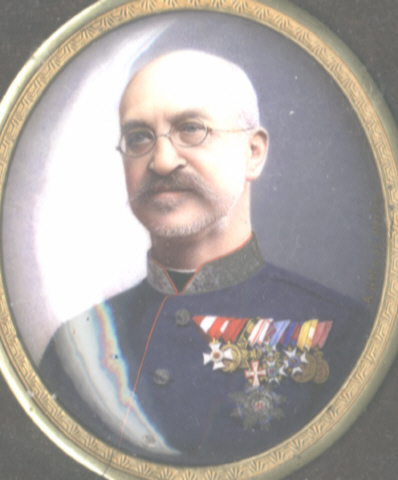
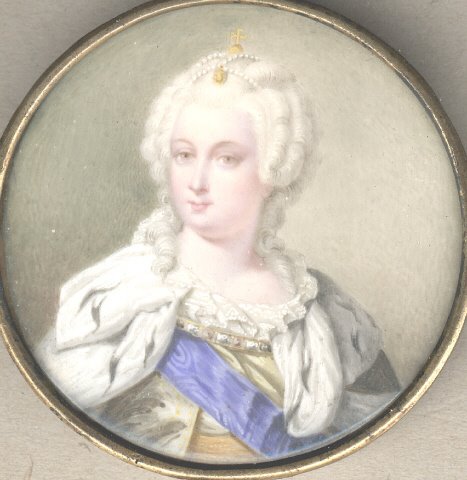
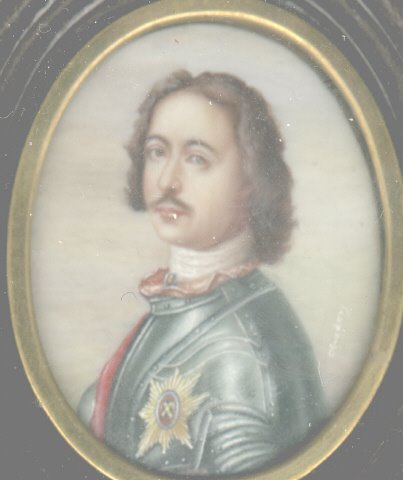
Elsewhere in this collection are a number of decorative miniature portraits of Russian monarchs. They include Peter the Great and Catherine the Great. 844a, 868

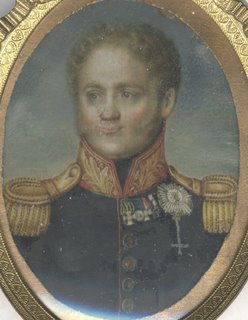
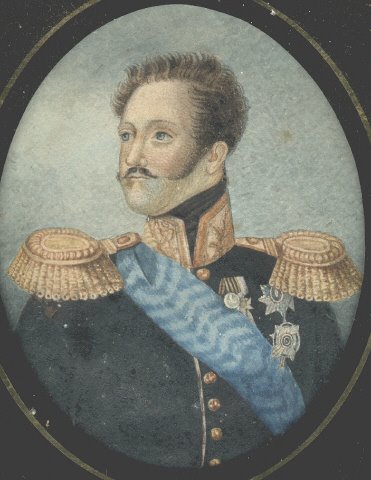
Also a miniature portrait by an unknown artist, which is a copy of a well known portrait of Alexander I (1777-1825) and one of Nicholas I (1796-1855). 1120 1058


Since 1990 the Russian royal family has regained nostalgic popularity, to the extent that decorative miniatures are again being painted, some of them are of a high standard. Shown here are four Russian miniatures painted since 2000. They are of Tsar Nicholas II and his wife Alexandra, together with two of his children, Grand Duchess Tatania amd Grand Duchess Anastasia.

This type of miniature is called Fedoskino or Palekh miniatures, after the Russian villages where many are still painted using lacquer on a papier-mache base. For more about them see Russian lacquer miniature - Fedoskino These can be purchased relatively inexpensively and would make a great basis for a collection for anyone interested in collecting miniature art, but with a tight limit on the amount of money they can spend.

Thus miniatures by Fedoskino artists provide a means of forming an attractive and inexpensive collection, and in doing so provide an insight into the times and events associated with the original sitters.

Morel-Ladeuil, Leonard - The Death of Andre Mazet, Barcelona, 1821

In collecting miniature portraits it becomes inevitable that one becomes attracted to items slightly outside the boundaries of a collection, but related to it and interesting in their own right.

One such an example is this French snuff box. There are 6 or 8 snuff boxes in this collection which have portrait miniatures as part of the decoration. Hence this one looked interesting, especially as it has a medical theme, as over two years have been spent researching the life and times of the 19C surgeon Sir Anthony Carlisle.

The snuff lid decoration is 70mm in diameter and is set into the lid of a composition or papier mache box. The material appears to be a thin sheet of gold applied to a thin sheet of copper, as the base, in a similar manner to Sheffield Plate. The design technique is repousse, which means raised in relief, as a design on a thin piece of metal hammered through from the underside. A similar effect can be achieved by pressing or stamping a design, but the detail on this example appears too fine for that.

As discussed further below, there was a yellow fever epidemic in Barcelona in 1821. A French medical team including six physicians and two nuns was sent to Barcelona to provide assistance. Dr Rocheaux (aka Dr Rochoux) one of the French physicians at Barcelona during the epidemic, states in his book on yellow fever printed in 1828, that in the early part of the epidemic the mortality was in the proportion of 19 out of 20 of those infected, that towards the middle it became much less, and at the close was only two thirds.

The doctors can be seen tending the victims in tented cubicles on the right, with the two nuns, acting as nurses, standing at the rear. A doctor, perhaps Dr Rochoux, sits at the front mourning his colleague, and wondering about the cause of the epidemic. An angel is conveying to heaven, the soul of Dr Andre Mazet (seen here) who has just died, while placing a wreath on the obelisk. Death, as a skeleton holding the sickle of the Grim Reaper stands on the left and is raising the lid of an empty tomb. The tree is a weeping willow, ready to weep over the dead, but is outshone by the sun, shining brightly with pleasure at the positive efforts of the doctors. 

There are several inscriptions on it;
Bottom - DEVOUEMENT DES MEDECINS FRANCAIS A BARCELONNE 1821- which translates as commemorating "the devotion of the French doctors in Barcelona in 1821".
Left on obelisk - MA ZET - There are two interpretations. Firstly, Andre Mazet was one of the doctors who died two years after publishing his book, "Observations sur la Fievre Jaune, Faites a Cadix, en 1819". This was an account of a similar outbreak in Cadiz in 1819, with Mazet himself a victim of yellow fever contracted during the expedition to Barcelona. But secondly, and less likely, "mazette" is an old expression meaning "Nothing or Empty", with the funeral monument empty because the doctors have saved so many lives.
Left on tomb - ILS ME LES RAVISSENT - Death is implying, there is nothing here for me; "they (the doctors ) have taken all of them".
Left under tomb - MOREL F - for Morel fecit - Morel made it.

There were several French jewellers named Morel and this was likely made later than 1821 by Leonard Morel-Ladeuil. Alternatively, it may be an earlier piece by Gabriel-Raoul Morel (c1819-1838) who made the box showing here, or by Alexandre-Raoul Morel (c1833-1850)
LEONARD MOREL-LADEUIL (1820-1888), French goldsmith and sculptor, was born at Clermont-Ferrand. He was apprenticed first to Morel, a manufacturer of bronzes, under whom he became one of the most expert chasers, or ciseleurs, in France, and then to Antoine Vechte, to acquire the art of repousse (q.v.) - the art in which he was to excel. He studied further under J. J. Feuchere and then attracted the notice of the comte d'Orsay and the due de Morny, through whose recommendation the French government, desirous of popularizing the idea of the new Imperialism, commissioned him to produce the "Empire Shield." Napoleon III. notified his warm approval, but the trade, annoyed that a craftsman should obtain commissions direct, resented the innovation and thenceforward boycotted the young artist, whose beautiful and poetic vase, "Dance of the Willis" (the spirits dancing round the vase, above the lake represented on a dish below) none would take. He was encouraged nevertheless by a foreign dealer in Paris, Marchi, who employed him on statuettes, mainly religious in character, until 1859, when Messrs Elkington, in view of the great exhibition of 1862, engaged him to work in Birmingham for three years in repousse, assuring him a free hand. Following his silver "Night" came "Day," and then the "Inventions" vase, which placed him at once at the top of his profession. This was followed by the beautiful plateau called "Dreams," which was subscribed for (£150) by Birmingham as the town weddinggift to the prince and princess of Wales. Morel-Ladeuil's contract was then renewed for five years, but as a matter of fact he remained with the firm for twenty-three years at their London house, the first result being his masterpiece the "Milton Shield: Paradise Lost" (in repousse steel and silver), which was the sensation of the Paris Exhibition. It was bought by the English government for £3000, and thousands of copies made by "galvanoplastie" or electrotype were sold and spread all over the world. Then after "The Months" came another masterpiece, the "Helicon Vase," in steel, silver, and gold, priced at £6000, which in course of time was presented by the ladies and gentlemen of the royal house to Queen Victoria on her first jubilee. For the Philadelphia Exhibition (1876) MorelLadeuil produced "A Pompeian Lady at her Toilet," following it in 1878 with the "Bunyan Shield," a companion to the Milton. After putting forth his reliefs "The Merry Wives of Windsor," "The Merchant of Venice," and "Much Ado about Nothing," in view of his failing health he retired to Boulogne, where he died of angina pectoris on the 15th of March 1888, and was buried with much ceremony at Clermont-Ferrand. His total work, apart from the productions of his youth, numbers 35 pieces, which richly reveal his elegant and refined fancy and grace, his feeling for correct and dainty ornament, and his love of pure art marked by an elevated if rather sentimental taste and a noble style.

The following paragraphs from Yellow fever in Barcelona - Barcelona blog - Barcelona food ... provide the background. 
In the centre of Poble Nou Cemetery is a monument to the victims of the outbreak of yellow fever in Barcelona in 1821. The disease was brought by a boat from Cuba. The epidemic first hit the poor areas, and then the rest of the city. It is thought that at least 20,000 inhabitants died from the disease, that is a sixth of the total population (120,000). To the north, the French authorities took emergency measures by cutting off land and maritime borders and blocking French ports to Catalan vessels and defining a quarantine line along the Pyrenean border patrolled by 15,000 soldiers.

A French medical team including six physicians and two nuns was sent to Barcelona to provide assistance. Long after the epidemic had receded, the Pyrenean quarantine line was maintained by the French authorities for a hidden political purpose: Paris wished to contain Spanish Liberalism, a “revolutionary pest”. French troops engaged in the so-called quarantine line were used in 1823 to invade Spain, while French physicians returning to Paris were celebrated as heroes and benefactors of mankind although they had not provided any serious contribution to the therapeutics or the epidemiology of yellow fever. They were glorified in publications of the time. This unexpected manifestation of nationalism was welcomed and encouraged by the government of Louis XVIII who felt himself threatened by the liberal opposition.

There is an oil painting as shown here, by Henri Auguste Cesar Serrur (1794-1865) titled La Mort de Mazet which was painted in 1861. It is in Musée des Beaux Arts de Cambrai.

The events, including the death of Mazet, "Mort de Mazet", are also depicted in a set of engravings kindly made available on the Internet at Léon-François Hoffmann, LA PESTE À BARCELONE. En marge de l ...  where larger images of those below can be seen.


It is not known whether there are multiple copies of the snuff box or if this was a single example. Other similar snuff boxes signed Morel are known, as shown here. The one on the left was offered for sale on eBay and that on the right offered for sale by Trinity Antiques on Ruby Lane, and described as "The high carat gilded medallion depicts Jesus Christ being delicately tended and lifted from the tomb. This medal was sculpted by one of the Morel brothers, famous for their quality. The detail is very fine. We can see the crown of thorns removed on the ground. Alongside are the nails and pliers. A cherub bathes Jesus's feet whilst the other two tend his upper body wounds. The words JESUS-CHRIST AU TOMBEAU (Jesus Christ Without The Tomb) surround the scene and below the arrows MOREL.F."

The third example has a portrait of George Washington and was offered for sale by snuffbox.com. 1411

Friday

Unknown - portrait of a patriotic Frenchman

Although this miniature portrait is unsigned, and of an unidentified man, it is interesting as an indication of the effects of the French Revolution on men's dress.

The man is no longer wearing a powdered wig of the 1780's and is now proudly wearing the colours of the revolution.

Although it looks a little like a military uniform, it is perhaps more likely just to show his allegiance as a an "advertisement" and so to avoid potential persecution, or even the guillotine, as a reviled aristocrat.

The condition is less than perfect, but it was painted by a very competent artist.

It is 55mm in diameter, so is smaller in size than became common after 1800. 1407

Renoldguy (?) - portrait of a unknown man

A valuable reference for collectors of French miniatures is Les Peintres en Miniature by Nathalie Lemoine-Bouchard. But, unfortunately, the artist who painted this miniature does not seem to feature in that dictionary, nor in Blattel, and hence appears to be a previously unrecorded French artist.

The signature is very hard to read and any assistance in identifying the artist would be gratefully received. It appears never to have previously been out of its frame, and so the faint writing is compounded by dirt which has seeped under the glass for over 200 years. It has been possible to brush some of the dirt off with a dry brush, but it is still very hard to read.

One guess is Renoldguy, but that is not a French name, neither are "renoldque" nor "renalaque"; another possibility is to read it perhaps as : Renold pinx

The artist is seen to be competent, without being outstanding. The main interest being the discovery of a previously unrecorded French artist who appears to have worked around 1790.

The miniature is only 60mm in diameter and so comes within the French modest school, that is a miniature of smaller size, rather than suggesting it is by an artist of modest ability. 1406

Thursday

Bossi, Domenico - portrait of a man in a navy coat

Eight and ten years ago, fortunate purchases for this collection, on two different occasions, were two miniatures acquired for very modest prices, which on receipt turned out to be by Domenico Bossi (1765-1853) an Italian artist born in Trieste, but who worked in several different cities.

Although his style can vary, some of his miniatures are quite distinctive, and since then anything resembling his work tends to stand out.

Bossi is a prized artist and hence a very fortunate acquisition at a local auction was this miniature portrait, described only as, "A Late 18C Circular Portrait Miniature on Ivory of a gentleman in a gold frame with memorium hair backing. Estimate $250-$450". It was listed among twenty lots of decorative and other miniatures of little value, so was very much out of place at the auction.

As it looked like a Bossi, it was necessary to inspect it, fortunately the auction house was quite close. On viewing the miniature, although perhaps a little faded, it was possible to detect a faint signature on the left starting D B..... This confirmed a feeling it was by Bossi. The reverse has two shades of hair laid at right angles, together with a damaged label which is unfortunately illegible as it may have shown the name of the sitter.

Fortunately, no one else picked the artist and it was purchased for less than the high estimate.

On opening the miniature the signature was only marginally clearer, but by enhancing the sharpness and contrast of the image, as seen here, it became possible to read the signature as "D Bossi 1795".

Schidlof describes Domenico Bossi (1765-1853) "as one of the best miniaturists of his period; in particular his works of the 18C are remarkable for expression and relief. In his first period he painted the shadows in surfaces using contrasts of sometimes hard light parts."

This aspect of Bossi's style is very apparent in this portrait, as the facial features are in a single colour, but made apparent by different depths of colour.

The National Museum in Stockholm contains 36 works by Bossi, dated 1796-1815. Hence this miniature of 1795 is an early work by Bossi, who in between 1794 and 1796 was working in Hamburg. Then going to Stockholm until 1802. He also worked in St Petersburg, Paris, and Vienna

One of the other two Bossi miniatures, of Baroness Leopold Neuwall is dated 1816, when he was in Vienna, so is towards the end of his career. For more see   View  The second is unsigned but is of Carl-Ludwig (1755-1801), Hereditary Prince of Baden.For more see View

In comparing the portraits of 1795 and 1816, the increased range of colours used in painting the facial features is quite apparent. 290, 492, 1409


Curiger - wax portrait of a man

This is a wax miniature portrait from around 1815-1820. It is unsigned and the sitter is unknown.

The portrait is well modelled and is very similar to portraits by members of the Curiger family of Switzerland. Their work is normally on a slate background, whereas this one is on paper. The family was very well known in the late 18C and early 19C, and there were seven of them who modelled in wax.

It is unusual for it to be on a paper background, as that was nor rigid enough to support the wax, thus I am inclined to the opinion that the original background was broken at some stage, and the sculpture was then mounted on paper.

Wax portraits are even rarer than those on ivory, so correspondingly, fewer collectors ever see them, nor collect them. 1385

A wax miniature portrait in the collection by Joseph Benedict Curiger the Elder, can be see at;
Curiger, Joseph Benedict the Elder - portrait of man

Unknown - Decorated French soldier, 1915


This miniature portrait is of an unknown soldier. The portrait is signed and dated 1915, but the signature is illegible. It appears to read something like "Augesety 1915", but I cannot find a similar name in Blattel. Any suggestions as to the name would be welcome.

I think he is French by the colour of his uniform. As he appears to have no rank badges, presumably he was only a private. If so, he is very well decorated for a private. It is a bit hard to tell the decorations he is wearing, but I believe the medal is the Legion de Honor. In addition he is wearing a red and green ribbon to the right of that decoration. I think this means that he had been awarded a second decoration, but the medal itself was not available, hence he only had the ribbon.

The Legion of Honour, or in full the National Order of the Legion of Honour (French: Ordre national de la Légion d'honneur) is a French order established by Napoleon Bonaparte, First Consul of the First Republic, on 19 May 1802. There are five grades of the Legion of Honor as below, and it looks as if he may have the ribbon bar of the second Grade, that of Officer;
Legion Honneur GC ribbon.svg
Grand'croix
Legion Honneur GO ribbon.svg
Grand Officier
Legion Honneur Commandeur ribbon.svg
Commandeur
Legion Honneur Officier ribbon.svg
Officier
Legion Honneur Chevalier ribbon.svg
Chevalier

Ruban de la Croix de guerre 1914-1918.PNGThe colours of the second decoration appear to be red and green in horizontal bars. My knowledge of decorations is very weak, but red and green were the colours of the Croix de Guerre which was established on 2 April, 1915, so the date fits. However, the ribbon had vertical stripes, as this this example. Thus, it is either a separate decoration, or perhaps at the early stages of it being awarded in 1915, it had not been confirmed that the stripes should be vertical, and not horizontal.  The Croix was created by a law of April 2, 1915, proposed by French deputy Émile Briant. The Croix reinstated an older system of mentions in dispatches, which were only administrative honours with no medal. The sculptor Paul-André Bartholomé created the medal, a bronze cross with swords, showing the effigy of the republic.  

Expert opinion on his uniform and medals would be welcome, also any advice as to whether there is any faint prospect of identifying him. To have apparently been awarded both medals in 1915, and to have had his portrait painted the same year, suggests he had performed some heroic service.

If so, it is possible there is a photograph of him in French newspapers of 1915. 1392